INSIDE AI: Why Every Organization Needs an AI Policy (Even If You Haven’t “Rolled Out AI” Yet)
March 30, 2026
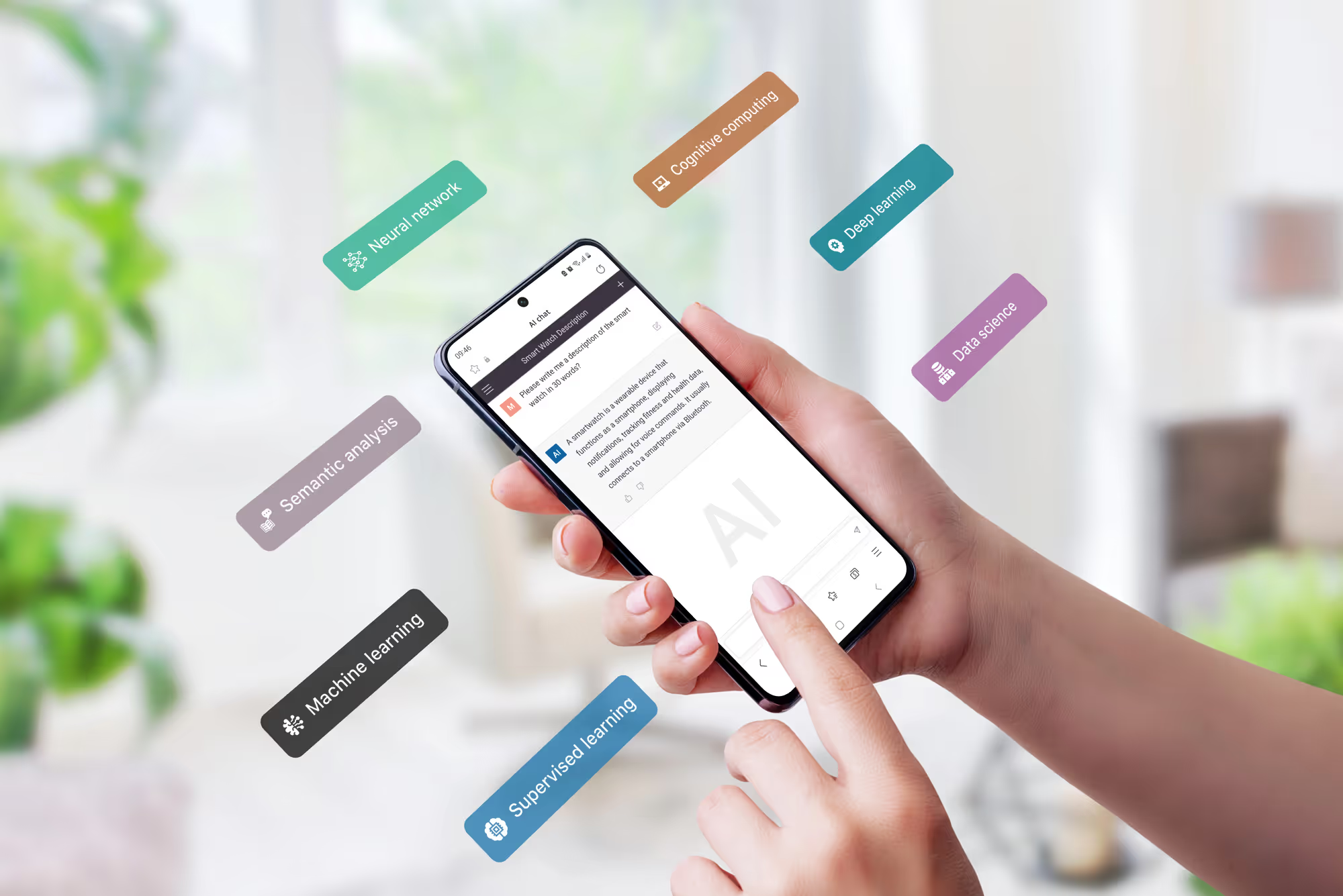
Let’s start with the obvious: your employees are already using AI.
Whether your organization has formally implemented AI tools or not, generative AI is embedded in the modern workflow. Employees are drafting emails with ChatGPT, summarizing notes with Claude, experimenting with Copilot, and using AI to brainstorm marketing copy, analyze spreadsheets, and outline strategy documents.
Some are doing it openly.
Some are doing it quietly.
Almost all of them are doing it.
That reality alone makes one thing clear: an AI policy is no longer optional. It’s foundational.
At FLEX, we believe organizations shouldn’t start with the tool. They should start with the policy.
The Risk of Pretending AI Isn’t Happening
One of the most dangerous positions an organization can take right now is passive avoidance—assuming that if leadership hasn’t formally “rolled out AI,” then AI usage isn’t occurring. It is.
Without a policy in place, employees are left to decide for themselves:
- Which tools are safe
- Whether free versions are acceptable
- What information can be entered
- Whether client or customer data is “probably fine”
- Whether they should hide their usage
That ambiguity creates risk on multiple levels.
Data Exposure Risk Scales Quickly
If your organization handles client data, customer records, financial information, proprietary IP—or in worst-case scenarios, patient data—the risk compounds immediately.
Free AI tools often use inputs to train their models. Without enterprise-grade protections, encryption, and a contained company instance, sensitive data can leave your ecosystem entirely.
We’ve already seen examples of employees pasting confidential strategy documents into public AI systems for summarization. Or uploading spreadsheets that include personally identifiable information.
The most concerning part? Many employees don’t even realize that what they input may not be protected. An AI policy clarifies:
- What tools are approved
- What data is strictly prohibited from being entered
- What security standards must be met
- What the consequences are for misuse
Without those guardrails, exposure isn’t hypothetical. It’s inevitable.
The “Turn It On and Hope” Horror Story
When Microsoft Copilot launched, many organizations rushed to enable it company-wide.
The logic was simple: It’s Microsoft. It must be safe.
But turning on AI without a policy—or without carefully auditing permissions—created unintended consequences.
Copilot was connected to SharePoint libraries, Teams chats, internal files, and HR documentation. In some cases, employees outside of HR were able to surface sensitive compensation data simply by prompting the system creatively.
No breach. No hack. Just poor governance.
The issue wasn’t the tool itself. It was the lack of intentional boundaries before implementation.
A strong AI policy forces organizations to pause and ask:
- What systems will this connect to?
- What permissions already exist?
- What shouldn’t be discoverable?
- Who has oversight?
The organizations that write policy first implement tools more strategically, and far more safely.
Here’s another version of this problem and it’s far more common than most leaders realize.
In a prior consulting engagement, I joined a project where the client was very explicit about their comfort level with technology. They were uneasy about recorded meetings. They were cautious about AI. They had expressed concerns about risk.
And yet, they required extremely detailed meeting notes — borderline transcription-level documentation, identifying who said what, in fast-moving conversations.
Shortly after joining the engagement, a team member onboarded me and casually explained that they had been using an AI-driven transcription tool to generate those notes. It wasn’t framed as wrongdoing. It was framed as efficiency. “It’s the only way to keep up,” they said.
But there had been no client consent for transcription. There had been NDAs in place. And there was no internal AI policy clarifying whether this was permissible, prohibited, or required to be disclosed.
I was new to the project. New to the team. And coming from a regulatory background, I immediately recognized the exposure. I had to escalate it to leadership. What followed was department-wide training, corrective conversations, and a very uncomfortable reckoning.
The employees involved weren’t malicious. They weren’t trying to circumvent safeguards. They were trying to meet client expectations efficiently.
But in the absence of policy, people fill in the blanks themselves.
No one had outlined:
- Whether AI transcription tools were allowed
- Whether client consent was required
- What data could or couldn’t be processed
- What the consequences were for misjudgment
So they made a judgment call. And the organization absorbed the risk.
AI Policy Is Also About Psychological Safety
The conversation around AI is often framed in terms of risk mitigation and compliance. That’s important. But it’s only half the story. The other half is culture.
When ChatGPT first entered the workplace, there was a quiet anxiety around using it. Employees joked online about “hiding” AI-assisted emails from their managers. Others worried they would be replaced if leadership knew how efficiently AI helped them work.
In organizations without clear guidance, AI usage becomes an under-the-table activity. People experiment privately. They hesitate to disclose. They feel mild embarrassment or fear about admitting they collaborated with a machine. That culture is inefficient and unsustainable.
A thoughtful AI policy does something powerful. It normalizes responsible use. It says:
- We support AI as a tool.
- You will not be punished for using it appropriately.
- Here’s how to use it in alignment with our values.
- Here’s how to disclose it.
- Here’s what we do and don’t monitor.
That clarity reduces fear. And fear reduction improves performance.
The Editing Problem No One Talks About
During an AI audit at FLEX, one of our writers shared something revealing.
They described the psychological difference between editing a draft they know came entirely from someone’s head versus editing a draft that began as an AI-assisted collaboration.
If they suspect something was generated by AI but aren’t sure, they hesitate. Should they take a heavy red pen to it? What if the writer poured themselves into that draft? What if aggressive edits feel personal?
But when a colleague discloses upfront “This first draft was AI-assisted. Please tear it apart.” the energy shifts.
The editing becomes cleaner. Faster. Less emotionally charged. Disclosure removes ego from iteration.
A good AI policy creates norms around transparency. It doesn’t require footnotes on every sentence. But it establishes when and how AI collaboration should be acknowledged.
That clarity doesn’t just protect the organization. It improves creative output.
What A Strong AI Policy Should Include
An effective AI policy is not a vague statement about “using AI responsibly.” It’s operational. At minimum, it should address:
Approved Tools
- Which AI platforms are sanctioned?
- Are enterprise versions required?
- Are personal accounts prohibited for work use?
For example, if your organization uses an enterprise version of ChatGPT, employees should not be inputting company data into personal free-tier accounts elsewhere.
Data Boundaries
- What categories of data are strictly off-limits?
- What can be summarized or analyzed?
- Are anonymization standards required?
Be explicit. “Confidential information” is too broad. Spell out client data, compensation information, legal documents, health information, etc.
Disclosure Expectations
- When should AI assistance be disclosed?
- To whom?
- In what format?
Clarity here eliminates anxiety and fosters trust.
Security and Permissions Governance
- Who evaluates new AI tools?
- How are integrations vetted?
- How are file permissions audited before enabling AI overlays?
Training and Education
Many employees do not understand how generative AI systems use data. A policy should be paired with training so teams understand:
- How models learn
- What happens to free-tier inputs
- The difference between enterprise and public tools
- The risks of prompt injection and data leakage
Consequences
Policies without consequences are suggestions. Spell out what happens if employees knowingly violate data protections.
The Cost of Not Having One
Organizations without AI policies face:
- Increased likelihood of data leakage
- Regulatory and legal exposure
- Reputational damage
- Internal mistrust
- Shadow AI usage
- Poorly governed tool implementation
- Cultural anxiety and secrecy
The risk only scales with size. The more employees you have, the more experimentation is happening. And the longer you wait, the harder it is to retroactively create order.
Policy is the Starting Line, Not the Finish Line
An AI policy should not be a static document buried in your intranet. It should be:
- Living
- Updated as tools evolve
- Aligned to your values
- Reinforced through leadership behavior
When leadership models transparent, responsible AI usage, it signals that innovation and safety can coexist.
At FLEX, we believe the organizations that win in this next era will not be the ones who move fastest, but the ones who move intentionally.
AI is not a future issue. It’s a current behavior. And policy is how you shape behavior before behavior shapes you.

Ready to FLEX?
When you're ready for strategic support that adapts to your unique needs, FLEX Partners is here to help. Connect with us to explore how we can empower your success.